
Smart HVAC Solutions for Schools & Universities
A school district’s biggest expense after payroll is its utility bill. Because the HVAC system is a major component of a school’s utility bill, careful evaluation of a school’s HVAC requirements and equipment options can help administrators save money while actually improving learning productivity.
Every school is different, so there is no one HVAC solution for all schools. Instead, there is a “best” solution for each individual school—chosen from careful evaluation—that maintains the highest possible indoor air quality at the lowest possible energy costs. A well-designed HVAC system maintains space temperature and humidity conditions, as well as minimum outdoor air amounts, economically and efficiently. ASHRAE standard 62.1-1999 recommends that each person in a classroom receive 15 cu. ft. per minute of fresh air, and a classroom with 30 people requires a ventilation rate of about 450 cfm. Factor in a school’s age, size, construction—such as walls, lights, doors and windows—zone requirements and the climate where the school is located, and it’s easy to see why schools present unique challenges for meeting HVAC requirements. The key is knowing how to balance all the elements of the equation.
Zone requirements are particularly important for schools. Each school has several different zones, each with specific needs for heating, cooling and ventilating. Classrooms generally have high ventilation requirements, three times that of an office, but only when occupied. Dedicated classrooms, such as science and computer areas, require extra cooling or ventilation. Administrative areas require lower heating and cooling, but are occupied over longer hours. Cafeterias need special ventilation for food preparation, and gymnasiums, occupied during the day and evening, have a range of load requirements and scheduling demands.
A variety of types of equipment and configurations are available to meet the requirements for schools.
Decentralized systems provide heating, cooling and conditioning, i.e., humidity control, to individual classrooms or zones. The advantage of a decentralized system is that it can provide cooling to one space and heating to another. Scheduling can be zone specific to allow for increased operating cost savings. Ideal for new or existing buildings, decentralized systems are easy to service and can rival the most advanced built-up systems for energy efficiency. A disadvantage is that the equipment resides in or near occupied spaces, so maintenance needs to be scheduled when the affected zone is not occupied.
What are the effects on paper?
Unit ventilators

Water-source heat pumps
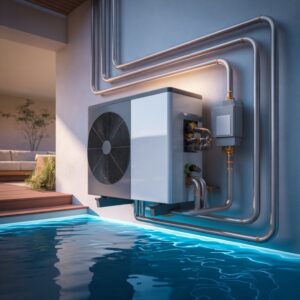
Versatility makes water-source heat pumps a good choice for medium and large schools, schools with large internal zones and retrofit applications. Rather than rely on a central chiller plant for cooling, heat pumps move energy around the school in water rather than air by adding and subtracting energy from a common loop. Because of the loop system, heat collected from cooled zones can heat zones that require heating. Heat pumps don’t require insulation, which reduces first cost. Unlike unit ventilators, they require outdoor air systems to bring in enough fresh air to meet ventilation requirements.
Fan coils
Like water-source heat pumps, fan coils distribute energy through piping rather than ductwork. Fan coils require a chiller and boiler plant, as well as a dedicated outside air system. Because they do not require compressors, fan coils are quiet.

Outdoor air ventilation systems
Central systems
Unlike decentralized systems, which control individual zones, a central system controls many zones, such as a block of classrooms, the administrative area or the gymnasium. These all-air systems condition air in a remote location, such as a mechanical room or on a roof, and distribute it through ductwork to the occupied spaces. Remote equipment can be quieter and easier to service because it does not reside in occupied spaces. However, because they serve larger areas, redundancy should be carefully considered in the design of the system in case it experiences downtime.
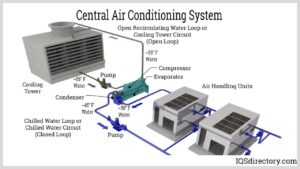
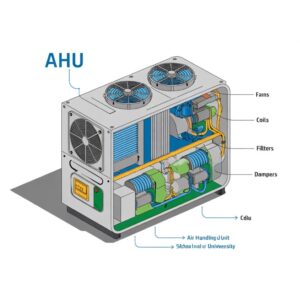
Central systems can be complicated to design and install, commission and operate. Ductwork can be large and difficult to fit in a ceiling plenum. Keys to successful operation are BAS, computerized controls that monitor and operate heating and cooling throughout a building. Central systems include air handling units and chiller plants, rooftop systems and vertical self-contained systems.
Air-handling units
Chillers
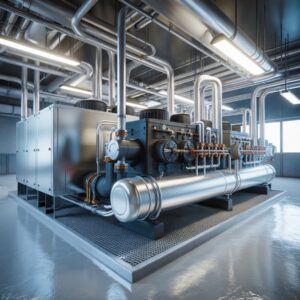

Applied rooftop systems
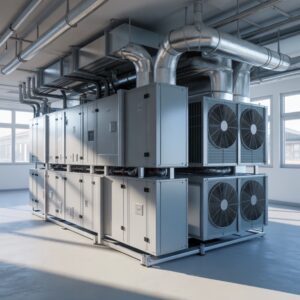
Indoor vertical self-contained systems
HVAC controls
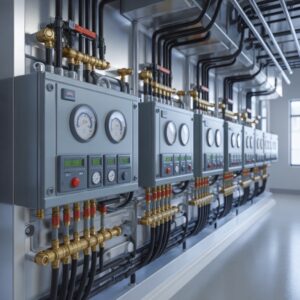
No matter what HVAC system is chosen for a school, the system will require computer controls to monitor and adjust heating and ventilation rates. Systems can be designed for remote monitoring, from the administrative office, or for individual classroom temperature control. Sophisticated systems, such as McQuay MicroTech II ä Controls, are interoperable with a district’s entire BAS. The key benefit of controls is their ability to reduce operating costs. Knowing how well a system is operating allows the facility manager to make adjustments to improve performance and lower energy consumption.
In all, the best HVAC system is the one that best fits a school’s requirements, both in terms of budget and performance. Each school has specific needs that can be met with the right system and design. Choosing equipment designed especially for a particular school will provide efficient, effective operation from first cost through the life cycle of the product.
WCSIPL has vast experience in designing & delivery systems suitable for different school applications.
Industries We Serve
Primary & Secondary Schools
Colleges & Universities
Vocational Training Institutes
Administrative & Common Areas
Key Benefits
- Optimized air quality and comfort for students and staff
- Zone-specific heating, cooling, and ventilation
- Energy-efficient HVAC systems tailored for schools
- Reduced utility costs with advanced controls and equipment
- Long-term, reliable solutions for diverse school environments


Why Choose WCSIPL for Educational Facility HVAC?
- – Educational Facility
Frequently Asked Question