
Precision HVAC Solutions for Laboratories
Air-conditioning in laboratories plays a critical role in ensuring both testing accuracy and personnel comfort. In most cases, the specified environmental conditions are designed not only for the materials being tested but also for the comfort, safety, and efficiency of laboratory personnel.
While the specific temperature and humidity requirements may vary slightly from the standard laboratory condition of 23°C (73.4°F) and 50% relative humidity, similar air conditioning systems—with minor modifications—can be used across various laboratory environments.
However, different types of laboratories have distinct air-conditioning requirements. These can broadly be divided into the following categories:
The Control Laboratory
Control laboratories are standardized and consistent in their operations. Every day, the same procedures are performed on the same materials under identical conditions.This includes:
- Fixed number of lights and personnel
- Identical heat-producing equipment
- Constant exhaust airflow and ventilation requirements
Such uniformity makes temperature and humidity control more predictable and efficient. The HVAC system’s role here is to:
- Absorb heat from all internal sources
- Maintain constant temperature and humidity
- Provide fresh air ventilation to ensure a safe and healthy working environment
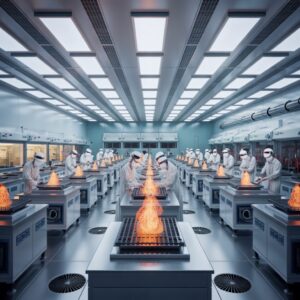

The Research Laboratory
Research laboratories are designed for flexibility. The workload, number of personnel, and type of experiments may vary daily. Therefore, the HVAC system must:
- Offer dynamic temperature and humidity control
- Handle variable heat loads
- Maintain air purity and filtration standards
- Support safe exhaust and fume extraction systems
Curling
- Stable yet flexible environmental conditions
- Energy-efficient systems to support pilot testing and prototype development
- Seamless integration with lab equipment and process ventilation

WCSIPL Laboratory HVAC Expertise
- Precise temperature and humidity control across varying workloads
- HEPA filtration and contamination prevention
- Energy-efficient air handling systems
- Compliance with ASHRAE, ISHRAE, and NABL standards
- Customized design for cleanrooms, testing labs, and R&D centers

- – Laboratories
Need more help?
We’re here to answer any questions you may have.