
Warehouse HVAC Solutions
HVAC is critical for warehouses because a lot of products are sensitive to temperature, humidity, and dust — and no consumer likes to receive damaged or defective products.
The key functions of an HVAC system in a warehouse are two-fold – maintaining the ambient air temperature or humidity to the desired levels for staff to work effectively and maintaining the Indoor Air Quality (IAQ) of the space to acceptable standards. ASHRAE 62.1 (2010) lays down the acceptable ventilation rates for warehouses. It is typically 10 cfm/per person but depends on other factors as well such as outside air quality, type of work, etc.
The temperature that is typically maintained in warehouses is around 28°C with a variance of 1–2°C. While no humidity standards are defined for warehouses specifically, the design aims for a humidity range of 55–65%.
Warehouse HVAC Design Segregation
The warehouse HVAC requirements can be segregated into two areas – the stowage section and the non-stowage section. The non-stowage section will cover office areas, restrooms, recreational areas, etc.
Stowage Area HVAC
Most warehouses are single-storey, big-box designs where the stowage racks are positioned. The racks may be 2–3 meters high in smaller warehouses or as high as 20 meters in large, automated warehouses. If there are no grocery or perishable items in the warehouse, then the space is only ventilated and not air-conditioned.
There are three main approaches that designers take to provide ventilation for warehouses:
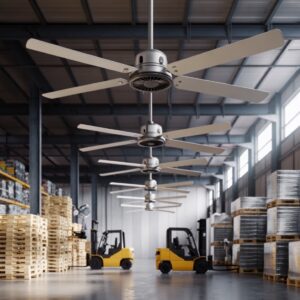
Ceiling Fans

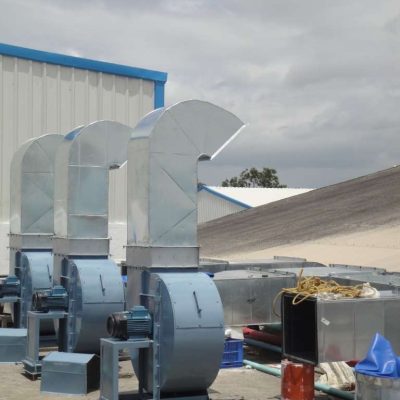
Exhaust Fans
HVLS Fans

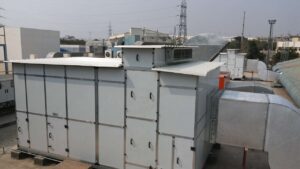
Air Washers
Non-Stowage Area HVAC

Importance of Ventilation
Ventilation of warehouses is important not only for maintaining desired air quality for the staff working there but also to prevent damage to the products that are stored.
The e-commerce supply chain relies heavily on good-quality warehouses where products can be shipped, sorted for dispatch, and stowed for future use. The staff working in warehouses are mostly blue-collar, but the whole distribution system relies heavily on this staff for stowage, retrieval, and packaging of the products — hence, good ventilation of the space is essential.
With the requirement for warehouses set to increase exponentially, the need for more advanced ventilation systems will arise and will further help in making the supply chain more effective.
- – Printing
Frequently Asked Question
Need more help?
We’re here to answer any questions you may have.
Why is HVAC important for warehouses?
What are the standard ventilation requirements for warehouses?
What is the ideal temperature and humidity range for warehouses?
What are common HVAC approaches used in warehouse design?
What challenges do exhaust fan systems face in large warehouses?
How does HVAC improve warehouse productivity?
Yes. WCSIPL designs and delivers custom-engineered HVAC solutions based on warehouse size, layout, stored materials, and climatic conditions.
Does WCSIPL provide customized HVAC systems for warehouses?
By maintaining consistent air circulation and temperature, HVAC systems create a more comfortable and safe working environment, improving staff efficiency and product preservation.